
For a while, more was more. Experiential became a showcase for what technology could do, and everyone leaned in hard. Then the pendulum swung the other way — toward the human, the tactile, the analog. But we’re not going to be making charm bracelets forever. So where does experiential tech go from here? The answer taking shape across the industry is surprisingly consistent: Tech as utility. Tech that serves the experience instead of trying to be the experience. Tech that makes it easier to gather.
Lauren Austin, XLISTER and chief creative officer at MKG, has watched the arc firsthand. “There was a long period, from about 2010 to 2019, where every brief I got wanted a never-before-done tech experience: 3D projection mapping, holograms, drone shows,” she told us in a recent Pro to Pro interview. “And now, post-Covid, in the world of AI, people want things that feel handmade, things they can touch, things that feel human. They want to, metaphorically, touch grass.”
BEHIND THE CURTAIN
Randy Weiner has never been a tech guy. The impresario behind The Donkey Show and Sleep No More (plus XLISTER) built his career on the most flesh-and-blood form there is: bodies in rooms, actors close enough to touch. His latest, Masquerade, is what he calls the most intimate person-to-person Broadway show imaginable. It’s also fueled by an enormous amount of technology.
“In order to make everyone’s personal analog experience happen, behind the scenes, we have a tech control system that is capable of launching a rocket to Mars,” Weiner texted (he doesn’t do laptops). “But the audience never has any idea about the digital stuff. All they know is they are sitting in a tiny dressing room with the Phantom as he looks them in the eye and holds their hand. That’s where tech and analog are going — or at least where I’m trying to go with it.”
IN YOUR POCKET
If Masquerade is what invisible tech looks like for immersive theater, a new class of tools is doing the same job at SXSW, Coachella, and CES.
Phil Neves and Jeff Swierk of Portrait Media Group have spent years producing industry moments and feeling overwhelmed by the sheer volume of official and unofficial events — and the antiquated spreadsheets and group chats required to figure out where to be. Their answer is Sumwhere, a discovery platform launching in beta at Cannes Lions, built to map the main conference and the sprawling satellite world around it.
“The core thing we’re trying to solve for is discovery and the ability to create your own agenda,” Neves explained. “The type of technology I’m most interested in is AI for the purposes of IRL. It enables your ability to connect in person and in real life.”
Jordan Kaye is making the same bet with Agent Analog, an early-stage AI event concierge that runs entirely over text — schedules, drink orders, introductions, photos, all by SMS, nothing to download. “What’s next isn’t a swing back to screens. It’s tech that earns its place by not asking for attention,” Kaye says. “The phone stays in the pocket; the tech works in the background — handling the logistics, the wayfinding, the ‘where do I go, what did I miss’ — so the human part gets all the oxygen.”
BEYOND THE ROOM
Nate Nichols, founder and creative director at Palette Group, takes the argument a step further: tech shouldn’t just serve the experience from the background. It can extend the experience’s reach.
The next era, as he sees it, is one where IRL and digital world-building are braided together rather than competing for the same attention. “AI lets us scale surprise and delight, which used to be the most expensive, least scalable thing in the business,” Nichols says. “The cost barriers drop, the geographic barriers drop, and suddenly, a moment that once required a million-dollar build can find you wherever you’re standing.”
His proof of concept is Rosé Run, a pixel-art game living at a URL, built for one festival week, where the satire is the experience. No booth, no badge scan, no app download.
WHY NOW
One explanation: The correction overcorrected. Going phone-free may work for an activation or concert — but it’s a response to a problem, not a plan for what comes next.
Another: We’ve seen this movie before. Social media promised to make us more connected, but research says it made us more anxious and more alone. Neves thinks experiential should carry that lesson into the AI era.
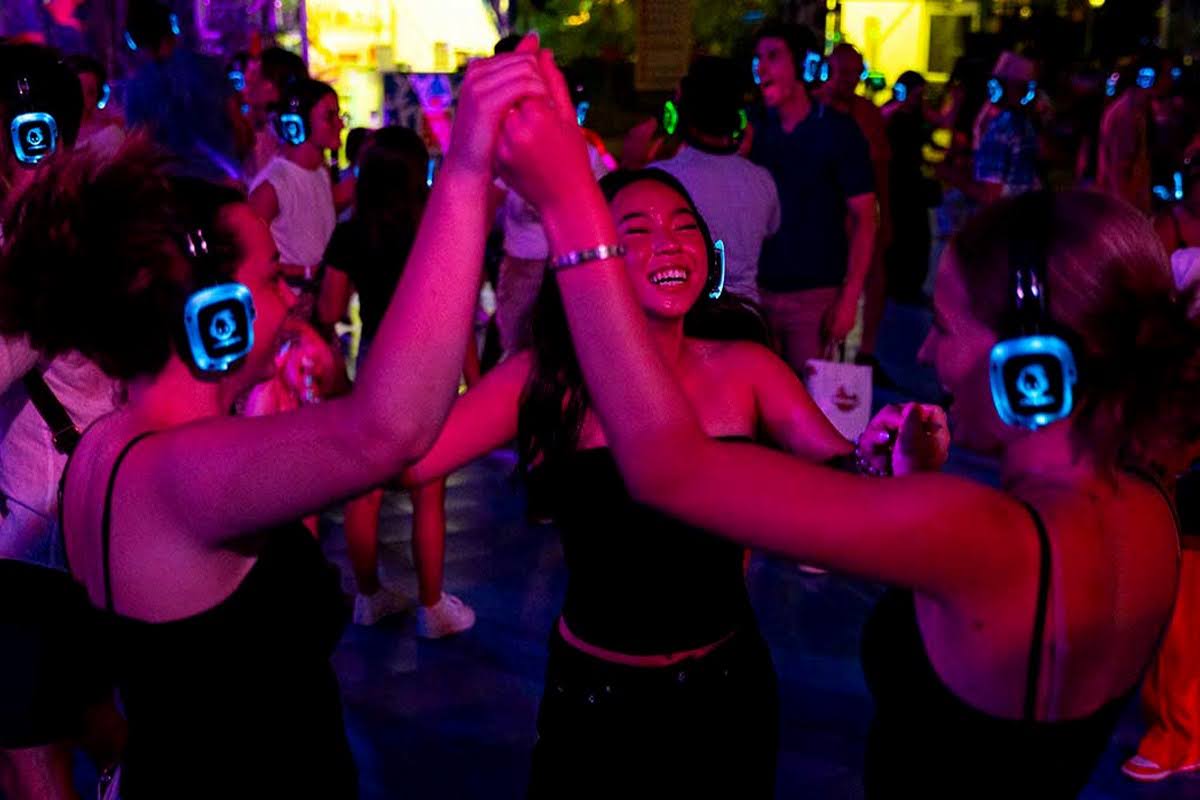
And then there’s The Dollhouse Project founder Lesly Simmons‘ explanation: “There’s not any truly mind-blowing tech,” she says. (And she has seen some truly mind-blowing tech.) She adds that because everyone has access to the same tools, tech alone no longer differentiates. People are chasing a different kind of novelty — a silent disco, a morning dance party — and using technology to find things to do that have nothing to do with technology.