
Every industry argues about what to call itself. What makes the experiential industry's version of this argument interesting is that the debate isn't really about vocabulary. It's about values — what we believe we're making, who we believe we're making it for, and whether the work we do is the product itself, the means to the thing itself, or something in between.
Earlier this year, we brought the question to two audiences: the XP Council, in one of our monthly Zoom salons, and our broader LinkedIn community, through a public poll. We asked experiential practitioners across the field to weigh in on 12 questions around what to call the industry, what to call the people who show up, which words to retire, which to reclaim, and where the sharpest friction lives between how we talk about our work and how we prove its value.
What follows is a snapshot of where the industry actually stands, contradictions included.
"EXPERIENTIAL" WON
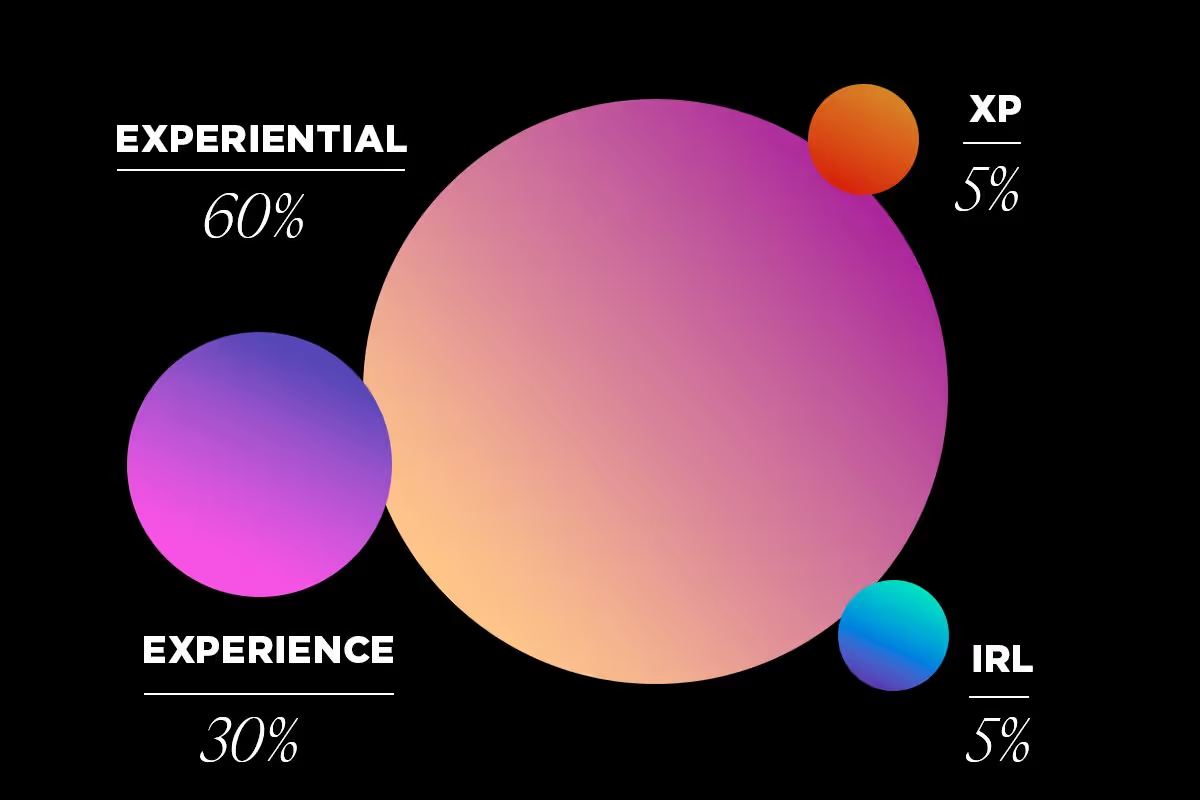
"Experiential" was the clear winner, with roughly two-thirds of respondents naming it as their preferred term for the industry. But almost no one chose it without a caveat. "The decision has already been made," wrote one respondent. "It's the broadest catch-all," said another. A third chose it because it feels like "movement, motion, emotion — and not jargon."
Of course, there were some voices of dissent. One respondent argued that no single term works across a field this diverse. Another chose “IRL” on the grounds that everything else has been polluted. "Everything is experience. Not everything is immersive. Not everything is live."
We say: Let’s own it, starting with a definition.
HOW WE DEFINE EXPERIENTIAL
Experiential is the intentional act of gathering people in a way that tells a story — from beginning to end — and culminates in feelings, growth, learning and connection.
This is a definition we’ve been workshopping for years. Here’s what makes it work:
The container is intentional gathering. People coming together by choice, at the same time, in service of a shared experience. That gathering doesn't have to be physical, but IRL remains the fullest expression of the form. When bodies are in a room, the stakes are higher and something becomes possible that can't be replicated or rewound.
The content is storytelling. There's an arc, a beginning and an end, meaning made through sequence. Without it, you have a gathering. With it, you have an experience.
The outcome is state change. People leave different than they arrived: more connected, more inspired, more themselves. That's the whole point. A billboard can inform. A video can move. But a well-crafted experience can change how people feel.
THE EXPERIENCE IS THE PRODUCT. THE EXPERIENCE IS THE CHANNEL. THE EXPERIENCE IS BOTH.
Just as important as defining experiential is understanding that while the experiential industry includes everything from festivals and immersive theater to brand activations and sporting events, experiences generally fall into one of two categories: Either the experience is the thing and the event itself generates revenue directly or the experience is a channel, a way to build loyalty or shift perception for something else.
But here’s the thing: Sometimes the experience is both, often depending on the client and the brief.
What this tells us is less about our respondents, who know exactly what business they're in, and more about the other side of the table. Clients who conflate the two models, or don't know which one they need, until something goes wrong. The brief asks for revenue and brand love. The budget is built for one or the other. The metrics are built for neither.
WE MOVE PEOPLE—WE JUST CAN'T PROVE IT YET
Speaking of metrics, the measurement question generated some of the most candid (and most frustrated) responses in the survey. There is broad agreement on the problem: The metrics that matter most to experiential practitioners are the ones that CFOs and investors trust least.
"We don't measure on long enough timelines," wrote one respondent. Another suggested a term worth adding to the glossary. "Depth of impression" is the idea that an elevated brand experience creates fundamentally different memory structures than a pre-roll ad, and that the industry hasn't yet developed the language or the tools to quantify that difference.
THE WORD FOR AUDIENCE IS REVEALING
We asked respondents what to call the people who show up. The answers split into three camps:
- The "guests" camp is rooted in hospitality: "If our most precious resource as humans is time, then approaching guests with a mindset of making them feel like they belong — that's the baseline requirement," was one response.
- The "attendees" camp prefers precision: One respondent put it most sharply: "A guest expects to be provided for. An attendee expects to be counted."
- The "participants" camp reaches for something more intentional: "It implies proactive consent, which should be a cornerstone of any experience design."
Perhaps the most interesting takeaway, though, was the near-universal rejection of "consumers." The resistance to that word signals something meaningful about where the industry's self-image has landed.
"IMMERSIVE" IS THE WORD WE LOVE TO HATE
If there is one finding that approaches consensus, it's this: The industry is exhausted by "immersive." It was the most commonly cited term to retire, named by respondents across backgrounds and roles. The reasons converge: overused, imprecise, destroyed by poor execution.
And yet, fascinatingly, "immersive" was also one of the most frequently named words to reclaim. Several respondents argued that the word itself isn't the problem; the problem is that it's been applied indiscriminately to work that doesn't earn it.
SO WHERE DOES THAT LEAVE US?
We don’t have solutions—yet. But we’re working on it. We’re building a living glossary from this conversation and the ones that follow. If you have a term to nominate, a definition to contest, or a strong opinion about any of the above, we want to hear from you.