
We've been heads down on something for Cannes and it has us thinking hard about brands doing experiential well right now.
So we made a list. It's not definitive. It's not ranked. It's not sponsored. It's an honest accounting of the brands that get experiential* right: some legacy giants, some fast climbers, all of them in the zeitgeist.
*Our definition of experiential is the intentional act of gathering people in a way that tells a story — one that culminates in feelings, growth, learning and connection. The best brands on this list understand the power of IRL, but also that the story doesn't end when people leave the room.
Bandit Running
Running is having a moment. Bandit got the memo.
Bandit was founded by runners and built for runners—and it shows. Their West Village store opens at 7am, has lockers for group runs, plus a café and a screen for watching races. The Bandit Grand Prix drew 1,200+ athletes and 1,000 spectators to the Brooklyn Storehouse in 2025—and it’s back for 2026. Think F1-style racing with heats, a DJ, food and a 3K final under lights. And back in 2024, the brand’s Unsponsored Project — providing 35 athletes at the Olympic Trials with logo-free kits, cash for expenses and a release clause so they could sign bigger deals — told you everything you need to know about Bandit.
Liquid Death
The water brand that refuses to act like one.
Liquid Death was built on the premise that marketing doesn't have to be boring (and neither does recycling). At Bonnaroo 2023, they created a country club within the festival and had attendees sign a sell-your-soul contract for admission. Inside: an air-conditioned gallery of past campaigns with an airbrush tattoo parlor where guests could get inked with Liquid Death logos. When they became the official iced tea of NASCAR, they didn't sponsor drivers. They sponsored fans: $30,000 contracts, car wraps and custom merch, awarded to whoever could chug a can fastest.
Starbucks
A global coffee chain reclaiming its origin story.
Howard Schultz brought the Italian coffee bar concept to America and built Starbucks around it: a place between home and work where people gather, linger and belong. For decades it worked. Then efficiency won and stores became glorified drive-throughs. Brian Niccol's "Back to Starbucks" strategy is essentially a public admission that the brand lost the plot—and a commitment to find it again. Comfy chairs back. Condiment bars back. Handwritten notes on cups back. 80-90 mobile-only locations are being phased out by the end of 2026. 1,000 stores are being renovated. A Coachella debut—their first—and a Starbies pop-up at SEPHORiA. Starbucks is betting people still want somewhere to sit, linger, meet up, work, flirt and waste an afternoon.
Hermès
Desire compounds long before a transaction happens.
No celebrity endorsements. No influencer gifting. No product placement. Hermès spends about half the industry average on marketing and just crossed €16 billion in revenue in 2025, outperforming a luxury sector under real pressure. The experiences they build instead: On the Wings of Hermès, a traveling theatrical performance blending dance, puppetry, cinema and music — or what experience researcher Laura Hess of REMARKABLE calls "experiential marketing without the marketing. Kelly bags sing opera. Gloves take flight. Then: Mystery at the Grooms, an immersive detective experience at Pier 36 in NYC, asked 25,000 visitors to find missing horses hidden inside a theatrical recreation of the Hermès universe.
Louis Vuitton
Maximum spectacle, maximum cultural presence.
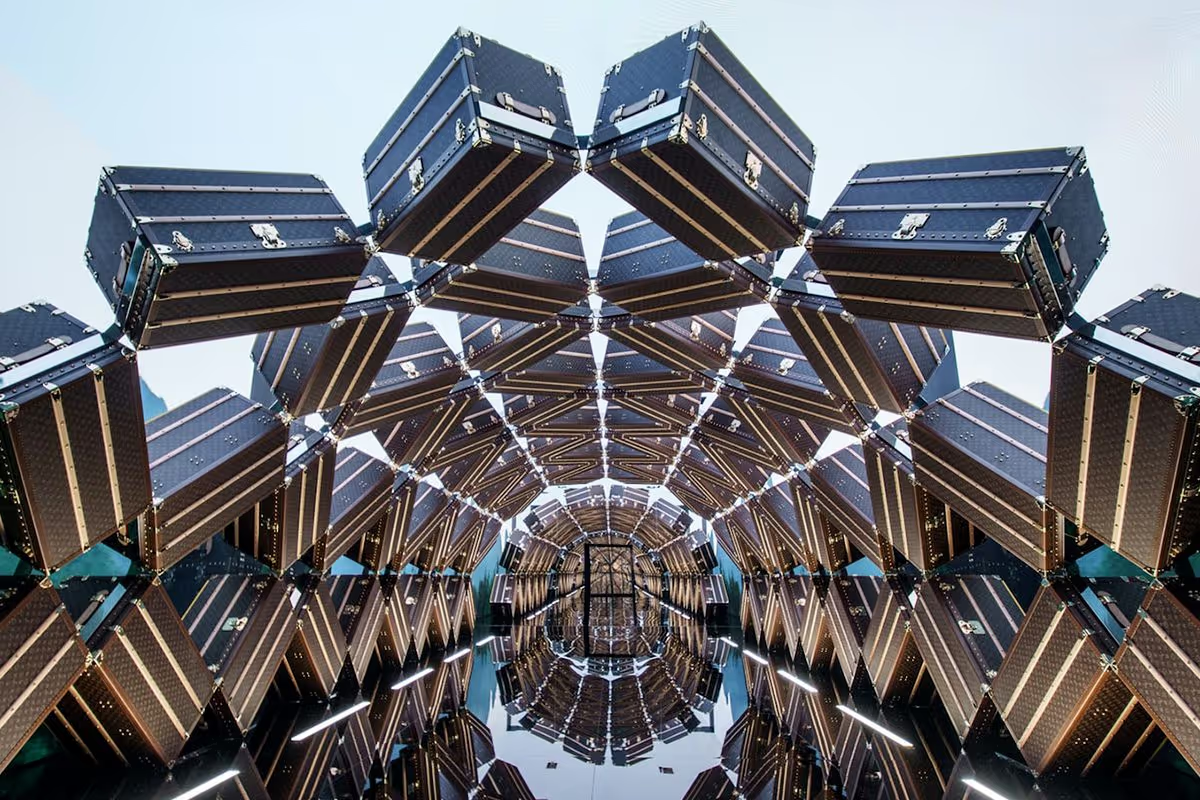
If Hermès proves that restraint is a strategy, Louis Vuitton proves the opposite works just as well. Visionary Journeys is a traveling branded universe — launched in Shanghai, now in Bangkok and Seoul — that folds immersive exhibitions, Michelin-starred dining and retail into a single destination. The Shanghai installation is housed in "The Louis," a ship-shaped structure anchored in the heart of the city; the Seoul location is currently the largest LV experiential space in the world. The thinking behind it isn't new. The Fondation Louis Vuitton in Paris, a Frank Gehry-designed contemporary art museum drawing 1.5 million visitors a year, has been making the case since 2014 that LV is as much a cultural institution as a brand.
Rhode
A beauty brand engineered for the moment and the feed.
Since launching in 2022, Rhode has followed the same philosophy: design every touchpoint — a product drop, a pop-up, a festival activation — to be experienced in person and shared everywhere else. A branded photo booth touring LA, Toronto, London and Ibiza. Color-coded pop-ups themed around specific products. A Rhode x Sephora launch event in Times Square in September 2025. Rhode World at Coachella 2026 was the biggest version yet — an activation choreographed around Justin Bieber's headline performance, launching the Rhode x The Biebers collection. Dart games, claw machines, a Sephora touch-up room, a food truck with a peptide lip treatment attached to every cup. No official festival sponsorship. $10 million in Media Impact Value anyway.
Ulta
A challenger that beat the category creator.
Ulta Beauty World launched in San Antonio in 2025 as a one-day consumer event bolted onto the end of their internal Field Leadership Conference. With 195 brands, 1,500 attendees and a swag bag worth over $1,000, it was smart and well-executed, but still a first attempt. Year two in Orlando told a different story: 3 million people flooded the ticket queue for 3,000 spots. They sold out in 71 minutes. The event brought over 5,000 people to Orlando and generated an estimated $7.6 million in economic impact for the city. More recently, Ulta teamed up with Method for Method Oasis, an off-grounds, invite-only creator hub and beauty and wellness destination at Coachella.
Alo
Experiential destinations, not stores.
Alo stores are called sanctuaries for a reason — yoga studios, meditation spaces, wellness cafés, up to 90 events monthly. You can show up, take a class, have a coffee and never buy anything. That philosophy extends well outside the store — to NYFW wellness programming and global retreats. Rumor has it the brand plans to make a splash at Cannes this year: a Hotel Martinez pier activation, a superyacht hosting Pilates and meditation in the Cannes bay before sailing to Monaco for the Grand Prix and new sanctuaries opening in Cannes and Saint-Tropez. "We are not opening stores,” said international CEO Benedetta Petruzzo. "We are building destinations that articulate a worldview."
Gap
A heritage brand remembers what it's good at.
Gap's comeback story has been well documented and Hoodie House at Coachella 2026 is the experiential proof point. As the festival's exclusive apparel sponsor, Gap built an on-site activation around a single icon — the hoodie — offering on-site customization with patches, drawstring beads and daily charm drops. It drew the longest lines of any brand activation at the festival, generated over 1 million views and a 5,000% search spike on brand-related queries. Our guess? It won't be the last.
Canva
A B2B brand with a B2C community.
Most tech conferences feel like tech conferences. Canva Create doesn't. The 2026 edition drew 6,000 people to Hollywood Park, where Canva's software interface became a physical world. Product features became hands-on experiences. There was a slide in the middle of programming. And brands like Mailchimp, LinkedIn and TikTok are now actively seeking to sponsor it. "Brands want to be a part of this," said Jimmy Knowles, Canva's global head of experiential. "That's a strong signal we're doing something right."
The Ordinary
A skincare brand that uses experience to prove its point.
The Ordinary’s experiential work follows the same logic as their products: no hype, no gatekeeping, just a clear-eyed argument that markups, mystery and celebrity aren’t the only approach to beauty. The Secret Ingredient Store filled its windows with branded dollar bills to show exactly what celebrity endorsements cost consumers. A global pop-up series on beauty pricing tactics turned its anti-markup philosophy into something you could walk through. A lab-inspired immersive experience demystified the science behind their formulas. And this summer, they launched The Ordinary Bus, a free shuttle connecting Williamsburg and Prospect Park, solving one of Brooklyn's most annoying transit gaps. No product push. Just a free ride.
Gucci
The luxury brand that just reminded you it's still Gucci.
Gucci's new creative director, Demna Gvasalia (formerly of Balenciaga), didn't opt for a quiet reset. He took over Times Square. The Cruise 2027 show spread imaginary Gucci products across 50 skyscraper screens, cast New York street characters instead of traditional models and invited guests with a brass key in an aged leather sleeve — a nod to the private Gucci Galleria that once existed above the Fifth Avenue flagship in the 1980s. Bold, referential and very public. One show doesn't make a strategy, but it caught our attention.
Gentle Monster
A store that makes you forget you're shopping.
Walk into any Gentle Monster location and the eyewear is almost incidental. In Paris, red velvet corridors and suspended metallic creatures lead to a rotating mirrored eye at the center of the room. In LA, scarecrows overlooking mother-of-pearl fields come to life as you pass—a quiet, zen meditation on pre-industrial Korean harvest in the middle of downtown. In Shenzhen, a three-level space envisions a speculative world in which humans and insects coexist over 10,000 years. No two stores are alike. Every installation changes seasonally. The product is there but the experience is the point.