

Experiencing sticker shock when it comes to Broadway shows? You're not alone. Reporting on rising ticket prices, the New York Times’s Michael Paulson writes of Shakespeare’s Othello, now playing at the Barrymore Theater, “If you’re among the many people who really, really want to see Denzel Washington as a jealous general, opposite Jake Gyllenhaal as a scheming Iago, it’s going to cost you: Most of the center orchestra seats, as well as a few rows in the mezzanine, are being sold for $921 apiece.”
Paulson rightly points out that not all theater tickets are exorbitantly priced. Last week, for example, an average ticket would set you back around $135. And you could score a seat at nine shows, including Harry Potter and the Cursed Child, for less than $50. Still, he concludes, “Tickets for the hottest Broadway shows are now out of reach for many.”
And it’s not just Broadway.
The Cost of Admission
Taylor Swift’s Era’s Tour and the Super Bowl both broke records, with average tickets going for $1,550 and $4,708, respectively. That trip to Disney World? The WSJ reports that a typical four-day visit for a family of four cost $4,266 in 2024. That's up more than $1,000 from five years earlier.
Rising ticket prices may be a sign that Broadway is back, but they're also an accessibility challenge. And some are actively seeking solutions. Hugh Jackman, for example, joined forces with producer Sonia Friedman to put on intimate and affordable productions in smaller venues.
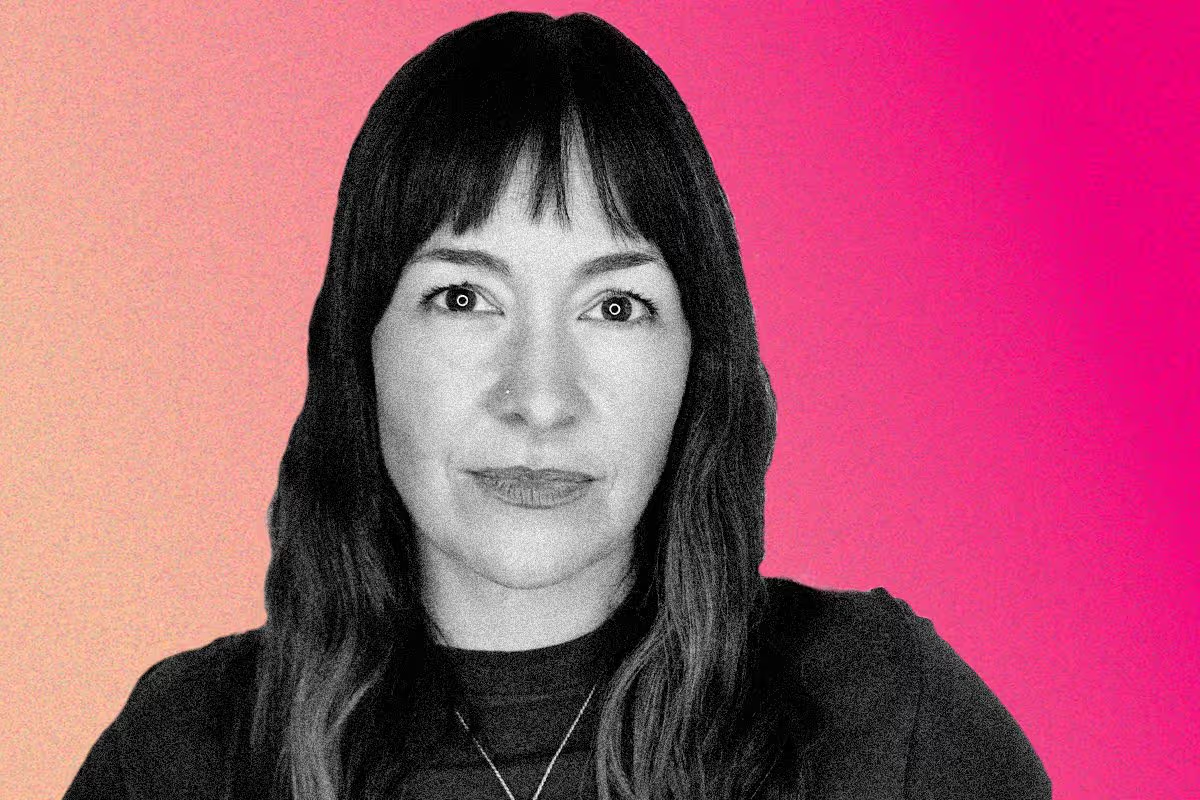
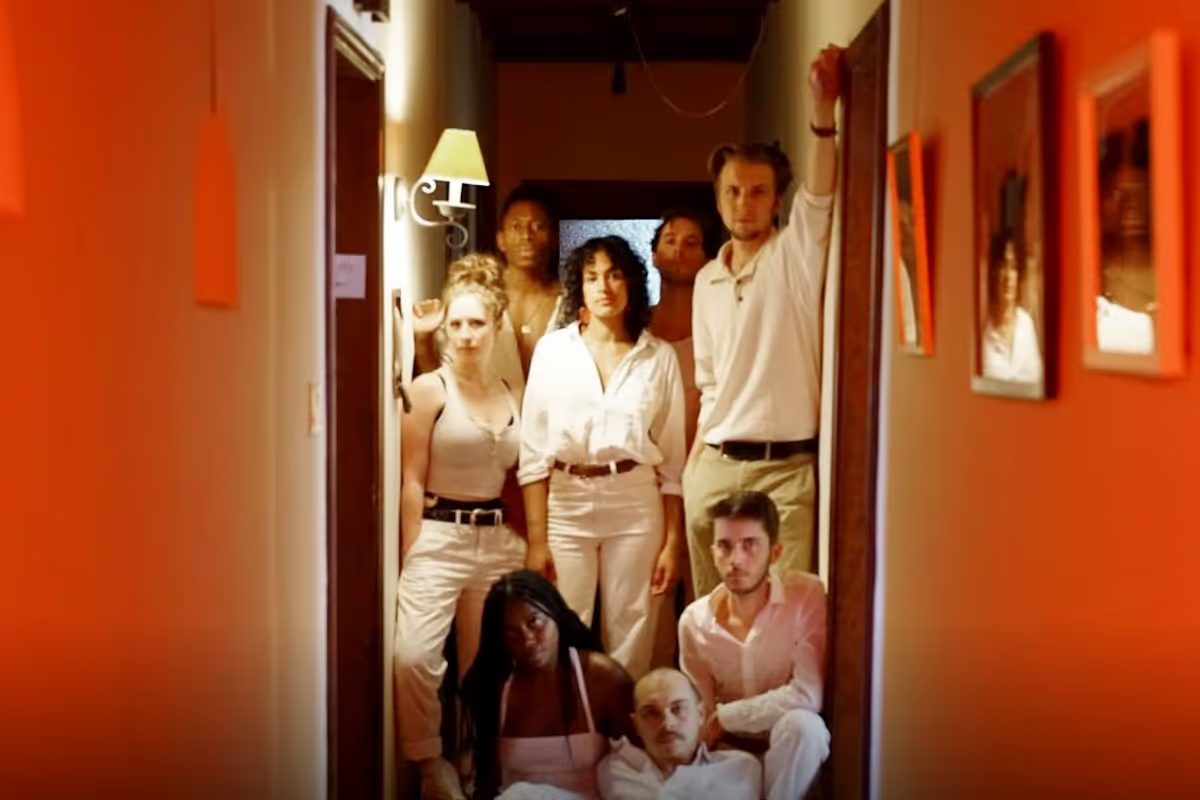
And in Santa Fe, New Mexico, it’s possible to see cutting-edge immersive theater for as little as $5. “We’ve never sold a ticket,” explains XLISTER April Cleveland, whose immersive theater group, The Exodus Ensemble, is donation-based.
We caught up with April to discuss building a sustainable business model that resists rising ticket prices, keeping audiences emotionally engaged, and finding inspiration from restaurants.
A Q&A with XLISTER APRIL CLEVELAND
Samantha Stallard: You have a unique business model. Can you tell us about it?
April Cleveland: We’re completely donation-based. We say after every show that a $10 donation to one person is the same as a $1,000 donation to another person. And then people are like, Oh yeah, I can pretty easily donate $400. And someone else is like, I can donate $5. It all balances out.
SS: How have you made that sustainable?
AC: We're very smart financially. There are a lot of things we could pay for that we don't. Like, the artists who are in the shows also run the company. So we keep the work condensed there, as opposed to hiring a development director or a marketing director.
And then we have donors who are really extraordinary, who saw the work a couple years ago, really believed in it, and want to put something extremely substantial and meaningful behind it.
SS: How has your audience changed (or not) since you started Exodus Ensemble?
AC: They've gotten younger, which is really exciting. The average person is older in Santa Fe, theater audiences generally are older, and so that combination really points towards older. But in any city, there are still young people. And I think over the years now, young people have found out more and more about Exodus. As word is starting to get out more generally, we're getting people with very different backgrounds mixing in one small audience every night. Different ages, different people who are involved in the arts, and then people who have nothing to do with the arts who are just interested in having a fun experience or a date night or who've come to Santa Fe and heard that this is a cool thing to do.
XPL: How do you keep your audience engaged?
AC: We have a lot of shock value. We don't stay in any image or place or mood or tone or even format of narrative for very long.
But I think the primary thing we do — the heart of our immersive theater — is extraordinary actors who are acting extraordinarily well. There's a lot of immersive theater where the environment is the key thing, but by making the actors the key thing, we're anchored in storytelling.
SS: Speaking of environment, you work in some unconventional spaces. What are some of the challenges and opportunities?
AC: We develop one new show a year. That show is created organically in a space, whether it's a house or a gallery, a work room or a train. And the restrictions of the space become opportunities. They’re instantly an ingredient of the “create mode” process.
But when we translate something, the show changes drastically. Like, for example, if Bathsheba was in a house, but now it's in a cathedral — which we just did. It's very hard, because things that were so powerful in one space are no longer revelations in a new space. You have to just surrender to the wilderness that you're going to be in.
SS: What inspires you right now?
AC: It has nothing to do with theater and everything to do with theater. I think some of the best event throwers, in an invisible way, are people who do restaurant service very well. People who are exquisite hosts know the secret to experiential. Everything is this seamless sequence of events where nothing is too long and nothing is too short, you’re never wanting for a drink and the salt is already there — but you're also not looked after like a hawk.
SS: What advice do you have for anyone in experiential?
AC: Challenge yourself to actually, actually achieve what it is you want the audience to experience. And I think usually that means shaking it up much more than you might think is necessary.