
As we gear up for the next XLIST, we’re revisiting members of last year’s class—taking a closer look at how they think, work, and shape the industry. (You can stay in the loop on nominations and announcements here).
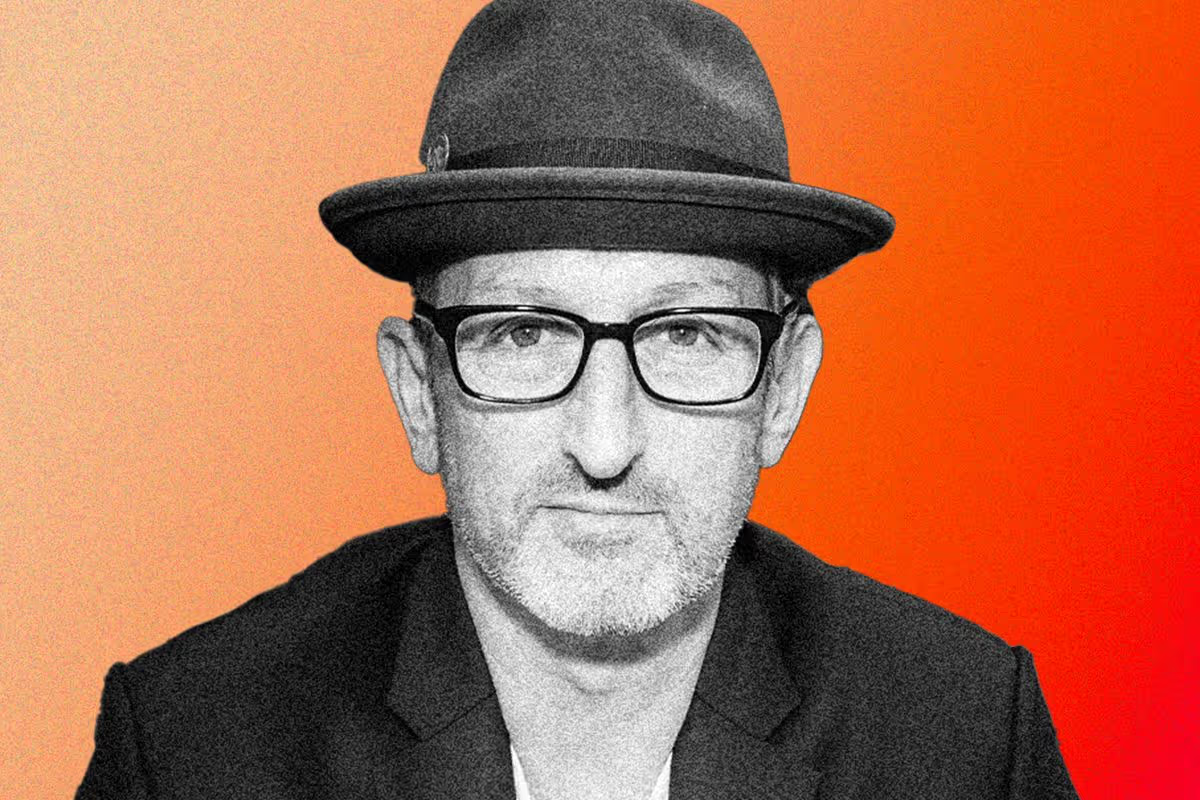
XLISTER Daniel Hettwer thought he would work for nonprofits. Instead, he found himself in renewable energy finance, which led to investing in a dome company and ultimately to spinning off Hidden Worlds. Now, as Chief Strategy Officer at Solomon Group, he's bringing his unique perspective to projects like Tales of the Cocktail, which he envisions as something much more than just a B2B spirits event. We chatted with Daniel about why the word "immersive" is like protein and what happens when we stop trying to overwhelm people with constant stimulation and start designing for balance.
Geraldine Campbell: What's your experiential origin story?
Daniel Hettwer: I studied economics, business, and psychology. My goal was always to get into a space with a positive impact and work for a non-profit. But I ended up in renewable energy finance, which sent me to China, where I invested in a dome company. It was ahead of its time. We were essentially building the Sphere or Cosm, but with a tourism angle. We had fully inflatable domes that could house 10,000 people. That’s how Hidden Worlds started. It was originally going to be a dome project. I partnered with Philippe Cousteau, the grandson of Jacques Cousteau, and Bob Ward, who is essentially the founder of Universal Theme Parks.
GC: You recently made the move to Solomon Group. Why? What do they do differently?
DH: Two things stood out. First, they're one of the only agencies that can credibly claim expertise across the full spectrum, from permanent experiences to live events and everything in between. Second, Solomon used to own fabrication and AV equipment in-house. While they have since exited fabrication, they retain the talent and expertise to manage the full supply chain. In an age of overpromising, this matters. A lot of agencies come in with beautiful renders, the CMO approves it, and then it's three times as expensive and takes five times as long. Knowing production reality is what lets you actually lead with strategy.
GC: One of your current projects is Tales of the Cocktail. What's the vision for where that goes?
DH: Tales has historically been very trade-focused and spirits-centric, but what makes it interesting is that structurally it already looks much more like SXSW than a traditional food festival. It’s spread across the city rather than a single venue, which means we have a much larger opportunity to build a citywide cultural platform at the intersection of food, beverage, hospitality, and experience.
What’s unique about New Orleans is that one of the city’s perceived weaknesses—the weather in July—actually becomes a major advantage. Because Tales happens during the summer, there’s far greater access to venues, restaurants, bars, and hotels across the city. That becomes the flywheel. Great venues attract top talent because chefs and bartenders want to work in iconic spaces with strong operators. Once the talent comes in, the audience follows, because ultimately people are chasing access to the best people and the best stories. Combined with attractive hotel and flight economics, it creates a very compelling platform for both operators and consumers.
GC: What would be a dream brief?
DH: There are two areas I want to do more in. The first is retail. I'm a huge believer in taking the learnings from brand homes and museums and bringing them into retail. You don't exit through the gift shop. It's a retail environment with an integrated storytelling mechanism. The other is hotels. People are after unique experiences when they travel. And I’m not talking about projection mapping.
GC: What's overrated in experiential right now?
DH: Immersive. People try to slap it on everything. It's like putting protein in your Snickers bar. It doesn't belong everywhere. Immersive is a feature. It’s one element. Think of it this way: If immersive refers to screen size and you’re only using your phone to make calls, does it really matter?
GC: What's underrated?
DH: Proper guest experience engineering. It can be as simple as surprising you with free parking. Eleven Madison Park used to go out and fill the coin meters for their guests. It cost almost nothing, but it really elevated the guest experience.
And then there’s execution: I'm so tired of people promising the world and having no clue how to execute it. If you sell something to a museum and they can't operate it because you didn't plan for staffing, you've made your money, but your client is suffering.
GC: You’ve said that experiential is still pretty young as an industry. How does it grow up?
DH: It hasn't been institutionalized yet. There are a lot of people with great ideas running around, a lot of thought leaders who've never built anything. To give you one example: guest experience engineering. The shift happens when we stop trying to overwhelm people with constant stimulation and start designing for balance. Sometimes the most impactful part of an experience isn’t another spectacle but a space to reset. There is a science to experience design that is being entirely disregarded.
We need to stop thinking of ourselves as the hero and start acting like the guide. We're Gandalf. We’re here to service our customers, not to build ourselves ivory towers. If we change that mindset and actually acquire the expertise to execute on what we promise — the whole space gets elevated. Because right now we really do have a trust problem, and the Willy Wonka and Barbie disasters aren't helping.