
As we gear up for the next XLIST, we’re revisiting members of last year’s class—taking a closer look at how they think, work, and shape the industry. (You can stay in the loop on nominations and announcements here).
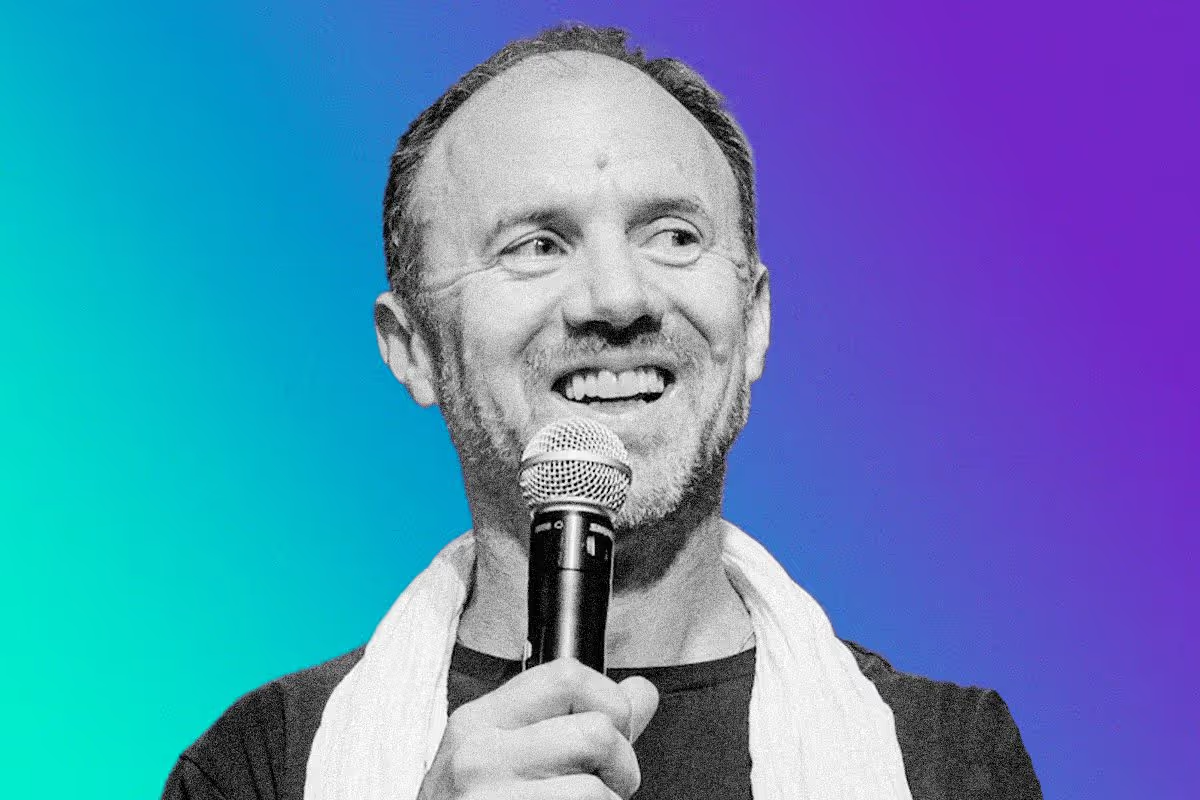
XLISTER James Wallman — experience evangelist, trend forecaster, best-selling author and CEO of the World Experience Organization — is solidifying London's position at the epicenter of the global experience economy. With London Experience Week 2025, he brought together 500 professionals from 33 countries for five days of bold ideas, secret dinners and the first-ever World Experience Awards, drawing leaders from Secret Cinema, BRC Imagination Arts, Punchdrunk and more.
On the cusp of London Experience Week 2026, we chatted with Wallman about the shift from excitement to accountability and his predictions for the industry’s next chapter.
Geraldine Campbell: The experience economy has been "the next big thing" for a while now. Are we still on the cusp — or have we arrived?
James Wallman: Arrived! The money is following, from investors and brands alike and as it does, the industry is maturing. That shift — from excitement to accountability — is how you know we're crossing the chasm to mainstream.
GC: You're heading into London Experience Week 2026 — what did Year One teach you and what are you doing differently?
JW: We learned that people come to connect and last year we didn't give them enough time. This year, we've slowed the pace. Shorter sessions, longer breaks. Space to actually meet, talk and build partnerships. Because people aren't just shopping for ideas; they're shopping for collaborators. They need time to dig deeper and create connections that turn into commerce. One conversation last year led to a $1.8 million immersive project.
We've also expanded participatory formats like the “unconference,” and added tools to help people connect in advance.
GC: You chose London as the launchpad, but the experience economy is happening everywhere. What would it take for Experience Week to move… or does it stay put?
JW: London is the right place to start: the world's biggest theatreland, Europe's hottest tech and investment scene, with a density that lets you see what's new and next while you're already here.
But it won't stop at London. We have the model. We just need to find the right partners.
GC: What's shifting in the experience economy right now that the industry itself hasn't caught up to yet?
JW: Two things: tech and measurement. Everyone is trying to figure out how to integrate technology meaningfully into real-world experiences. At the same time, there's a land grab for the best way to measure impact properly. There's progress — emotional tracking, behavioural signals, physiological data — but no clear standard yet. That matters because once ROI is clear and standardised, investment accelerates.
GC: What's flying under the radar in XP that deserves more attention?
JW: Functional experiences that are designed to shift how you feel, not just entertain you. You see it in immersive audio and sensory environments like Chromasonic, Emergence and Corvas Brinkerhoff's forthcoming Submersive. They incorporate the neuroaesthetics movement and a little of the 'drugs without drugs' ethos of the psychedelics movement — inducing altered states, the hypnagogic effect, without the substance. The potential is enormous.
GC: What's an experience that genuinely changed how you see the world — not as an industry example, but personally?
JW: Chromasonic and the HUM. They pulled the floor out from under me — I didn't know if up was down or down was up, if my eyes were open or closed, like I was flying through the jungle and space and the inside of the veins of a leaf. I loved every minute of them.
GC: Ten years from now, what does a world that takes experience seriously actually look like?
JW: A world where experiences are central. We go places not just to buy things, but to feel something. The quality will be higher, the failures fewer, the standards stronger. AI will make experiences more responsive. It won't replace humans; it'll support us. And we'll see a deeper convergence between gaming and real-world experiences. Not just gamification, but videogamification. You already see it in Punchdrunk's Lander23 and video game brands like Riot Games moving into IRL. And best yet, Poolhouse, which just opened, is a video-gamified version of classic pool. It's brilliant… even if I did lose.