
As we gear up for the next XLIST, we’re revisiting members of last year’s class—taking a closer look at how they think, work, and shape the industry. (You can stay in the loop on nominations and announcements here).
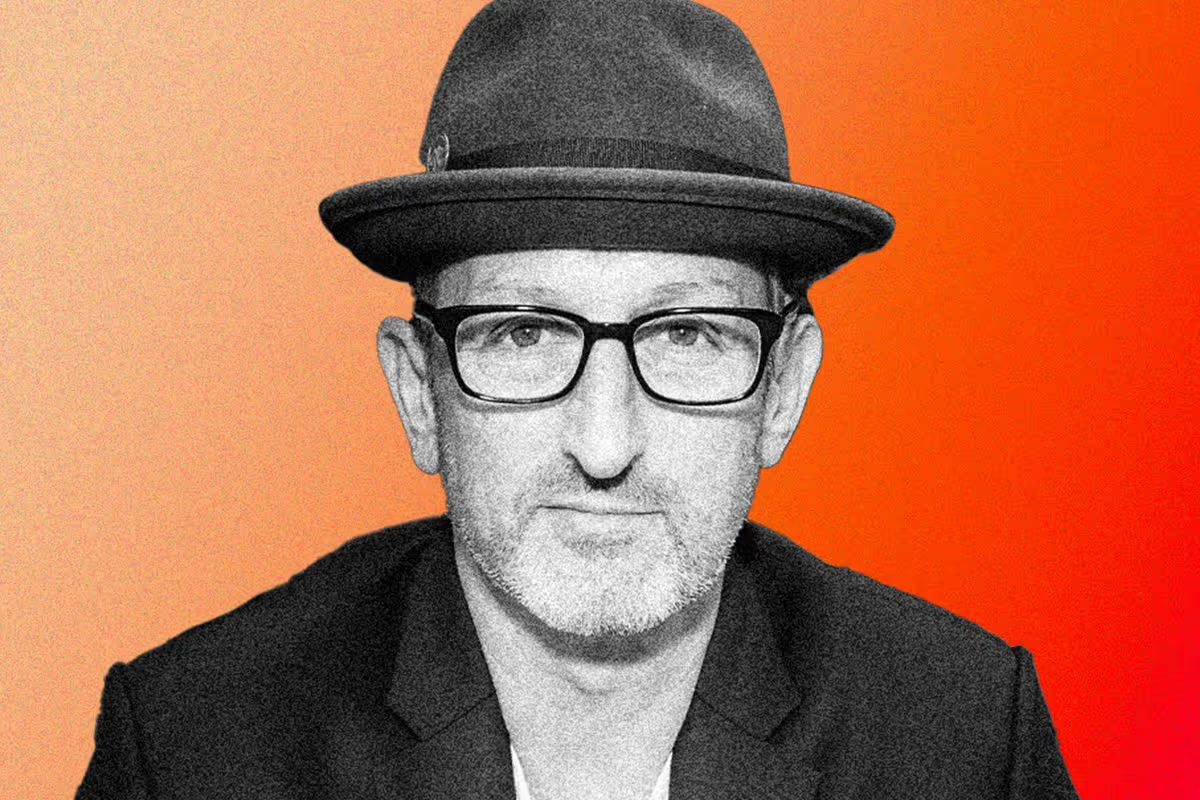
XLISTER Frankie Margotta is Associate Director of Strategy at TRIPTK, where he works at the intersection of brand transformation, research, and experience. His work spans global platforms and cultural moments—from leading the rebrand of CES 2025 to developing Netflix’s live-event sponsorship framework and evolving adidas’ adiClub into a membership experience rooted in IRL connection.
For Frankie, strategy isn’t a creative exercise; it’s a foundation grounded in rigor.
Geraldine Campbell: Was your way into experiential intentional or accidental?
Frankie Margotta: I kind of fell into it. I was studying graphic design at SCAD and thought that was the path I was going to follow. Then I volunteered for a 72-hour sprint where teams came together to rebrand a non-profit organization. It felt very familiar to think about systems, decision-making, and how everything connects. I realized pretty quickly that while I liked design, strategy was where I could move faster and have more impact.
GC: What are you focused on right now?
FM: At TRIPTK, we tend to work pretty far upstream. As a brand transformation partner, we’re helping companies think about where they’re going before it turns into campaigns or activations. A big part of that is research. I’m a researcher as much as I am a strategist. We do a lot of work in-house, so what we build is grounded in something real.
Culture has always been an input for us, not an output. That’s something that’s become more common now, but it’s how we’ve approached the work from the beginning.
GC: What’s a recent project that mattered?
FM: What comes to mind is recent work with a global category leader that we’ve been partnered with for over a year across multiple efforts. We started with brand strategy and repositioning, but it’s evolved into something broader—segmentation, qualitative research, and their employer value proposition.
What actually mattered was getting to a level of clarity the organization could believe in. Not just something that sounded good, but something they could look at and say, “Yes, this is us.” And that’s harder than it sounds. You’re not just defining the brand—you’re defining what it’s like to work there, how decisions get made, what the experience actually feels like internally.
GC: What do you wish more brands understood?
FM: I think there’s still some skepticism around strategy because of how it’s been done in the past. It’s been more of a creative exercise than something grounded in rigor. What we do at TRIPTK is really tied to research and methodology. It’s not just about having a point of view; it has to be something you can actually use.
GC: What’s overrated in experiential right now?
FM: “Authenticity.”
It’s become this catch-all that doesn’t really mean anything. It’s a relational concept. Something can be authentic to me and not to you, and we can both be right. But people talk about it like it’s universal.
GC: What’s underrated?
FM: Actually experiencing the work you’re talking about. There’s a lot of commentary and a lot of opinions, but not enough people actually going out and testing things, prototyping, seeing what works.
GC: Who is your dream collaborator and why?
FM: Y-3 or Fear of God. I’m really drawn to how they think about design and culture. There’s a strong point of view, but also a clear architecture behind it. With Fear of God, especially, there’s this balance between aspiration and accessibility that I think is really interesting.