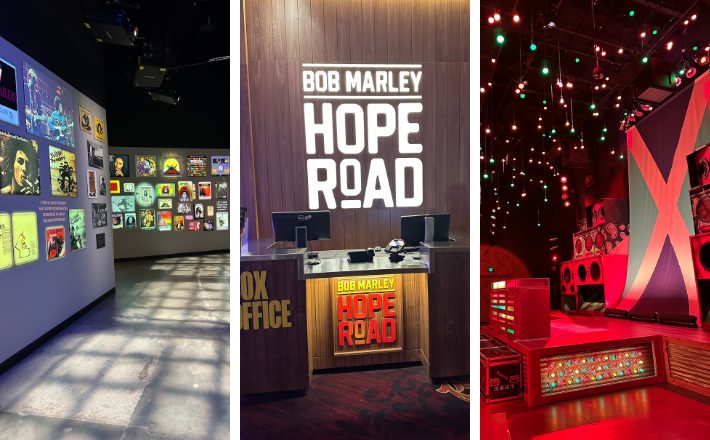

“Wa gawan?” (“What’s going on?” in Jamaican Patois) Welcome to Hope Road, the new Las Vegas spectacular celebrating the life, legacy and music of Bob Marley. Billed as “an immersive music experience,” the show is a joyous voyage with a loose narrative, excellent reinterpretations of Marley’s hits, impressive acrobatic dance and technology that supports the magic.
An accessible entry point for newcomers and a thoughtful reinterpretation for longtime fans, Hope Road succeeds by balancing the universality of Marley’s music with the specific moments of his life that reinforce his message of “One Love.” But is it actually immersive?
“Immersive” on the Marquee
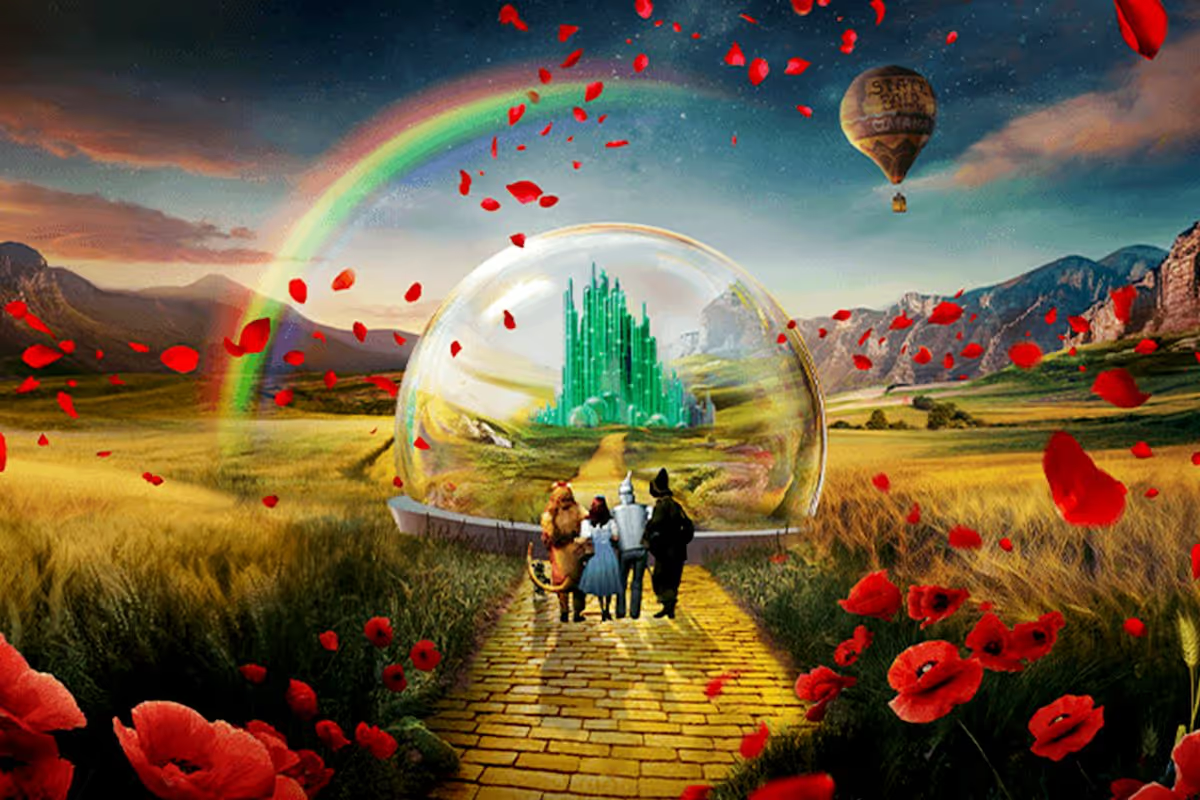
Click your heels three times and you’ll find yourself in The Wizard of Oz at Sphere, a “fully immersive 4D experience,” ready to follow Dorothy, Toto and their motley crew, rendered at a staggering 366 feet tall, down the Yellow Brick Road. Leaves swirl aggressively as the tornado drops Dorothy into Oz; butterflies flit through the venue as the Munchkins emerge; apples fall from the ceiling as Dorothy dodges angry trees; and the entire building shakes and quakes — thanks to haptic seating — each time the Wicked Witch appears.
The ingress experience alone is exquisitely designed. Ambient speakers make you feel as though you’re walking through a forest, complete with birdsong and rustling leaves. And the lighting signals luxury. It’s big, it’s loud and it’s unforgettable—but again: Is it actually immersive?
Just because immersive is the word of the moment doesn’t mean it’s the best descriptor—or the most effective way to attract an audience. Both of these attractions are immersive in the literal sense that water is immersive; they surround you. But real immersive entertainment is something different: It actually requires the audience’s participation in order to move forward.

What “Immersive” Actually Looks Like
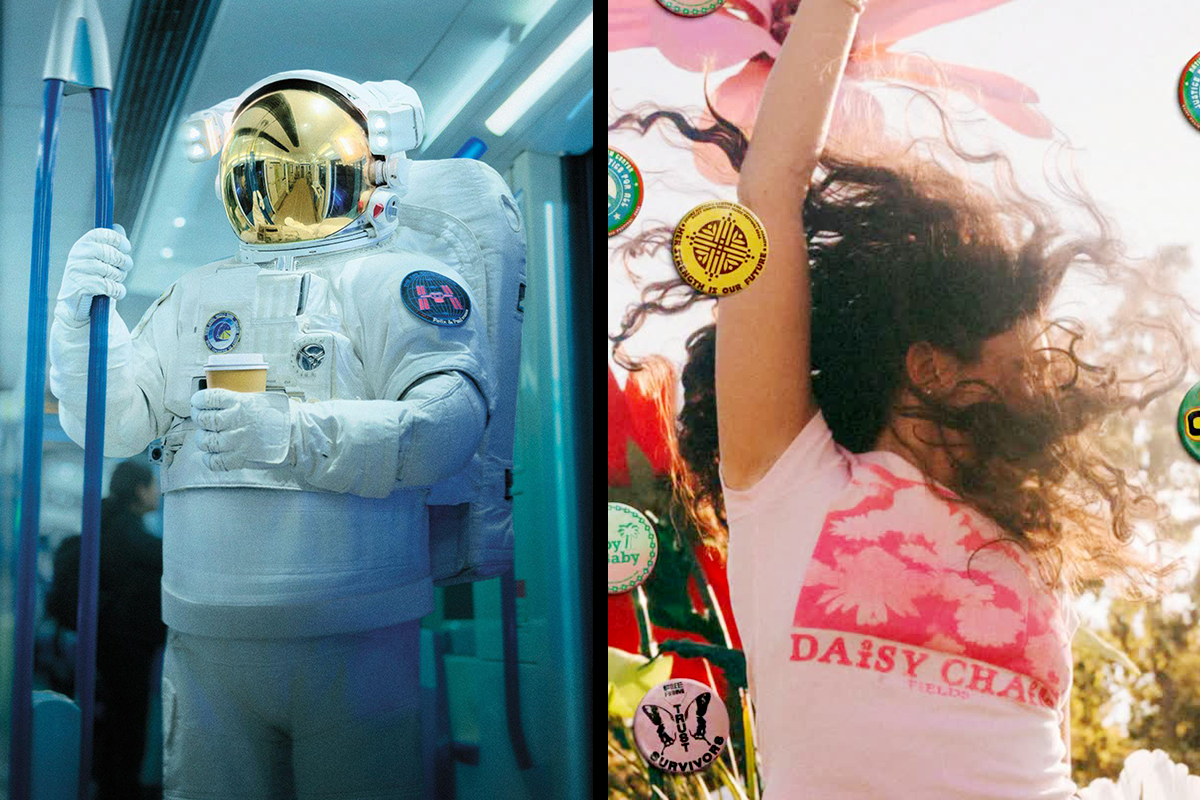
And then there’s Interstellar Arc, a multisensory experience from XLISTERS Paul Raphaël and Félix Lajeunesse of Felix & Paul Studios, that promises “an unprecedented depth of immersion.” Spoiler: In this case, it really is immersive. If Wizard of Oz and Hope Road sit at a one on the immersion scale, Interstellar Arc earns a full five.
The narrative begins before you even enter the building. From the outside, guests are primed to feel as though they’re stepping into a space hangar. Inside, the history of Arcadia, the destination planet, the ships that came before the Interstellar Arc, and the politicians building a new space-city called Cosmopolis are presented with museum-level gravitas. You genuinely feel like an explorer preparing to leave a familiar world behind. Even donning the headset is handled in-world: of course, you’d need a helmet and instructions before embarking on such a journey.
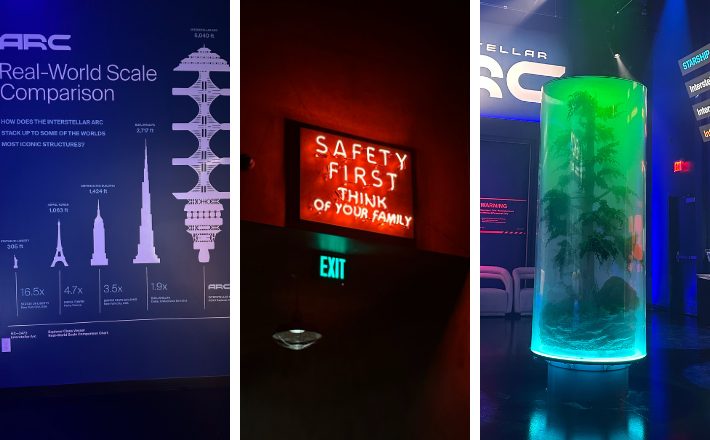
Once calibrated, the experience begins.
Astronauts sit in haptic-enhanced seats for launch, then “disembark” and roam different sectors of the ship with light guidance from AI beings (including Carl Sagan) and a holographic fox. There’s light gamification, the ability to communicate with other members of your group and opportunities to snap selfies or photos of Arcadia and the ship-city Cosmopolis, where humans are adapting to life in a new environment.
Achievements — mostly orb-catching and photo-taking — are saved to your account, suggesting future visits may unlock new challenges and storylines.
That last bit is what I think earns Interstellar Arc a badge of true immersion. It’s not only participatory, but it is dynamic and responsive to the guest. The experience is slightly different for each guest depending on how they use the technology, how curious and exploratory they are, and how many times they visit. For fans of the medium, I think these are defining characteristics of what makes a show or attraction immersive.
The Cost of Calling Everything Immersive
All of these experiences market themselves as “immersive” — and I’d argue it now has almost as many meanings as my favorite f-word. The difference, of course, is that the f-word is useful in nearly all its applications. “Immersive,” when used as a vague marketing catchall rather than a specific descriptor, only confuses potential ticket buyers.
One of the experience industry’s biggest challenges is agreeing on precise language to describe different types of attractions — language that helps reach the widest possible audience and sets clear expectations. As the business matures from a trend into a growth industry, a shared glossary will need to emerge to help audiences understand what they’re actually buying tickets for. It will mitigate issues like limiting one’s audience when it demands minimal participation to a casual audience that might be attracted by the subject matter or spectacle, and assist in attracting a more engaged audience when an experience truly delivers on the promise of immersive.
Perhaps we could collectively consider a ratings system for anything that wants to promote itself as immersive.
One star for minimally participatory and five for fully dynamic and responsive to the audience. Promoters would want to be “rated” not only to set audience expectations, but as a mark of quality by an “Immersive Experience Board.” Ticket buyers could be educated to look for the rating before buying a ticket to an event or attraction from an unknown source. This could both facilitate understanding and growth of the industry and also crowd out bad actors like the fake Bridgerton Ball or the disastrous Willy Wonka experience.
Crossing that threshold — through standardization, transparency and professional consensus — will be essential if we want the industry to grow.