
Welcome to XP Dispatch — our monthly look ahead at the events, gatherings and cultural moments shaping the experiential industry. Each issue, we go deeper on three. We talk to the people building them, participating in them and watching them closely. Consider it your field briefing for the month ahead.
The FIFA World Cup is back in North America for the first time since 1994: three countries, 16 cities, 48 teams, 104 matches and, somewhere in all of that, the sport itself. With brands, media companies and hospitality groups all scrambling to build their own version of a World Cup experience before the first whistle even blows, another event is taking shape around the actual tournament.
We're zeroing in on three host cities — New York/New Jersey, Los Angeles and Kansas City — three places throwing the same party and arriving at very different answers to a question the whole industry keeps circling back to: when an experience gets this big, who is it actually built for?
NEW YORK / NEW JERSEY
June 13 – July 19, 2026 | MetLife Stadium, East Rutherford, NJ
New York/New Jersey made the stadium so hard to reach that the most interesting experience moved across the parking lot.
MetLife Stadium will host eight matches and has only one real transit artery, NJ Transit. A train that normally costs $12.90 was, at one point, priced as high as $150 on match days. Governor Mikie Sherrill called out FIFA for pushing the cost onto residents. FIFA, which stands to clear billions, declined to cover it. The fares came down weeks later, after the fight had already played out in public.
Then, NYC Mayor Zohran Mamdani turned the mess into theater.
FIFA's dynamic pricing opens seats at $60 for loyal fans of the specific national team playing, and tops out at $6,700 for the final. Mamdani's answer was a lottery of 1,000 tickets at $50 each, free bus included, handed over as a winners' board. It fixes none of the economics, but it does deliver each city a template for claiming the event on behalf of the people who live there.
Demand doesn't evaporate just because the stadium is unreachable, by cost, transit or lottery luck. It goes looking for whatever room will take it. In this case, American Dream, the climate-controlled megacomplex directly across the lot from MetLife, has cast itself as the region's World Cup living room for all 39 days.
At the center of it is The Messi Experience, a 20,000-square-foot walkthrough of Messi's life and career spread across nine installations. It's an original Primo Entertainment property, designed by Moment Factory and brought to American Dream by RYVE | AONE, the FIFA-licensed agency staging the New York/New Jersey run. "We wanted visitors to step out of a passive viewing experience and into a 'hero journey,' where each zone feels like an immersive scene in a movie," said Jamie Reilly, General Manager, Sports & Entertainment at Moment Factory. The team reviewed more than 1,000 hours of archival footage and traveled to Argentina to study local football culture before building it.
The walkthrough runs about 75 minutes. Visitors build a profile on entry, hunt eight hidden Ballons d'Or, and play through shooting and ball-control games on the way past a recreation of Messi's childhood bedroom and an AR locker-room sequence. It ends with an encounter with an AI-rendered Messi and a selfie with him. "Even with all of our 360-degree mapping and 3D visuals, nothing replaces the physical, emotional impact of standing in that specific environment," Jamie said.
LOS ANGELES
June 12 – July 6, 2026 | SoFi Stadium, Inglewood, CA
Los Angeles may learn that a welcoming room is hard to design when the people inside it are afraid.
On paper, LA may be the most prepared host in the country: it has the most international population of any host city and the widest fan-zone footprint — the official FIFA Fan Festival at the LA Memorial Coliseum plus 10 community zones from Venice Beach to Pomona. The prep is done, but people are staying away because they've decided the country isn't safe to visit right now.
46% of travelers now say they're less likely to visit the US at all.
Mayor Karen Bass has urged the White House to publicly reassure international fans they won't be detained or harassed by immigration agents while they're here, an ask that only highlights how little say she has over it. Meanwhile, UNITE HERE Local 11, the union representing roughly 2,000 hospitality workers at SoFi, has threatened to strike if ICE is deployed during the matches and wants FIFA and stadium owner Kroenke to publicly commit that ICE and Border Patrol will play no role.
“We want the World Cup to be a welcoming event for everyone, but that can’t happen if workers and guests feel intimidated or unsafe,” said Kurt Petersen, co-president of UNITE HERE Local 11, in an interview with ABC News.
As of early June, those workers are still without a contract, weeks out from kickoff, while acting ICE director Todd Lyons has said the agency will play a "key part" in World Cup security, the precise outcome they're organizing against.
Between the labor fight and the security anxiety, the venue itself is still trying to do the simplest and hardest part of the job: prove it can absorb the scale, move the crowds and make the whole thing feel seamless once the gates open.
KANSAS CITY
June 16 – July 11, 2026 | GEHA Field at Arrowhead Stadium, Kansas City, MO
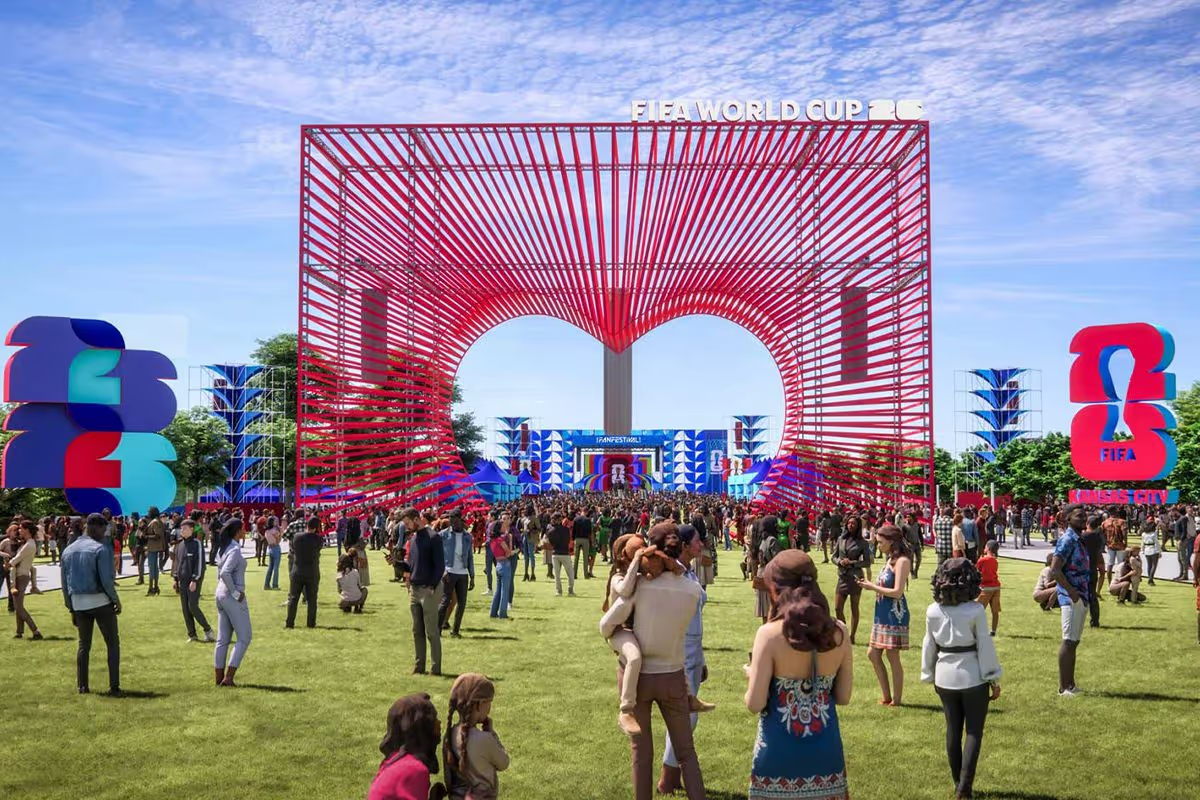
Kansas City is the smallest host city in the tournament, the only one that built something new to pull it off and the cleanest case study going into what it actually costs to show up at this scale.
The whole point of hosting at this size is the deadline, which forces a city to build what it would otherwise argue about for decades. Arrowhead Stadium sits southeast of downtown, historically reachable mostly by a thin schedule of bus shuttles. FIFA requires host cities to move fans and in a metro like Kansas City's size and sprawl, that requirement was effectively an order to build something that didn't exist. So they did. A new transit system: a streetcar extension, upgraded connections through Union Station (now the official World Cup visitor hub) and new infrastructure designed to move an estimated 650,000 visitors across a region that does not work that way on an ordinary Tuesday.
KC2026 CEO Pam Kramer has been careful about what legacy actually means here. "When you hear legacy, you think sticks and bricks — Centennial Park, something like that in Atlanta," she told KSHB, referring to the park Atlanta built for the 1996 Olympics. "For us, legacy is more about sustained and long-term impact... creating capacity, building workforce, teaching people how to operate or showing that we can operate regionally and creating a blueprint for how to do that."
Then comes the catch every host city eventually meets.
Kansas City just built better transit for six weeks of international tourists than it has ever built for the people who live there. The bus routes locals actually depend on didn't change. The new streetcar runs to the stadium complex and stops there. The neighborhoods that need transit most got six weeks of it.
For the experiential industry, Kansas City is the whole question in miniature. What does it mean to build something that runs flawlessly for the event and may not outlive it? The streetcar will still be there in August. Whether it ever serves the people who were here long before the cameras showed up is the answer that arrives slowly, long after July.
THE SIGN-OFF
So, when you build an experience this big, who is it really for? The World Cup will answer the way it always does, with sold-out stadiums, record viewership and a highlight reel where everything looks like it went fine. The truer answer is in the margins. A $50 ticket was handed to someone boarding a bus in the Bronx. A SoFi cook is weighing whether it's safe to come to work. And a streetcar in Kansas City running past the neighborhoods that never made the plan.
See you in the next Dispatch. Until then, we'll be on the ground, in the rooms and in the group chats.