Welcome to XP Dispatch — our monthly look ahead at the events, gatherings and cultural moments shaping the experiential industry. Each issue, we go deeper on three. We talk to the people building them, participating in them and watching them closely. Consider it your field briefing for the month ahead.
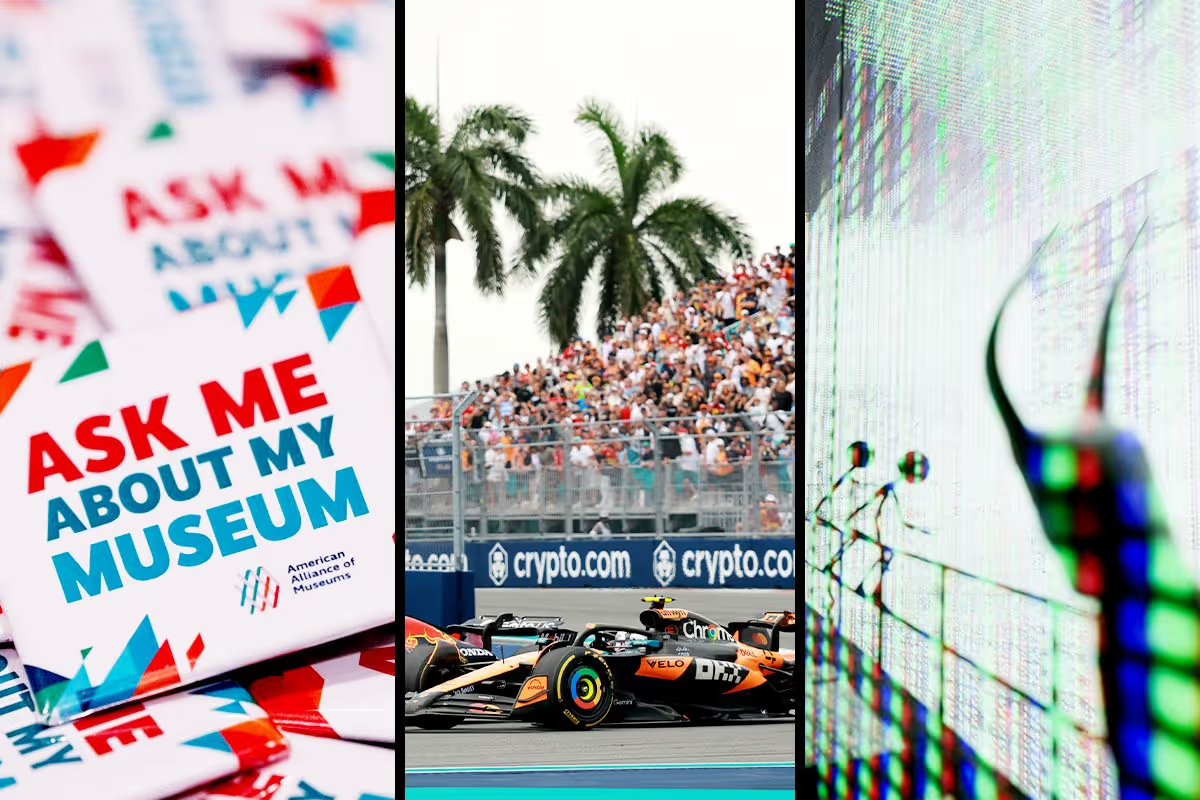
This month we're watching motorsport, music and museums. Three worlds that look nothing alike, all circling the same question: what does it actually take to make someone feel something in 2026?
FORMULA 1 MIAMI GRAND PRIX
May 1-3, 2026 | Miami International Autodrome, Miami, FL
Miami is the F1 race that figured out how to be a cultural festival, and the festival is what's growing the sport.
The 2026 weekend has the racing (sprint Saturday, Grand Prix Sunday) and the rest of what's now considered standard issue. F1's official Fan Fest at Lummus Park on South Beach is free and open to the public for the first time. The campus across Hard Rock Stadium is built around neighborhood-themed zones — Wynwood, Key Biscayne, Little Havana — with food, art and entertainment scaled to each. Miami is selling Miami first, and racing is the reason it's all happening this weekend.
The numbers say the model is working.
81% of single-day Miami Grand Prix ticket buyers in 2025 were first-time attendees, and 40% of ticket buyers are women — a demographic the sport has spent decades trying to reach. F1 signed a ten-year extension last spring that keeps Miami on the calendar through 2041, the longest active contract in the sport.
The reason it works, according to Rob Blasko, VP of Brand Entertainment at Public School and XP Council member, is the audience itself. "F1 attracts a hugely diverse audience, so everything from Tag Heuer to ServiceNow to Ritz crackers seems to reach a consumer target at these events." The audience Miami built pulled the brands in. The race created a room with no demographic ceiling, and brands go where the people go.
The open question is whether the weekend can hold this much weight. Every team, every sponsor, every adjacent luxury brand wants in, and at some point, the activations start competing with the racing itself.
Brand Prix is the easy joke. The real question is whether Miami's model (culture first, sport second) keeps producing fans or starts producing footprints.
RADIOHEAD: MOTION PICTURE HOUSE — KID A MNESIA
May 6 – June 28, 2026 | Agger Fish Building, Brooklyn, NY
Everyone will call Radiohead's Motion Picture House — a 75-minute audiovisual film, scored with multitracks from Kid A and Amnesiac and paired with a gallery of original artwork by Thom Yorke and Stanley Donwood from the 2000–2001 album sessions — immersive. The team building it would prefer you didn't.
"We've been deliberate about the language from the start,” says Natalie Stone of StoneWork, who is producing the run:“Movie and art installation. Not an 'exhibition,' not an 'activation,' and definitely not 'immersive.' Those words come with a set of expectations that aren't ours, and frankly, most of what gets called immersive right now is built as a diorama: a backdrop for content, not an experience for a human being."
That's the bet the project is making. Whatever you call it, it's designed to make you feel, in Thom Yorke's words, like "a Monster trapped in a derelict museum of the lost and forgotten. A relic of a time when technology could have saved us." That tells you exactly what kind of room you're walking into.
After its Coachella debut in a 17,000-square-foot bunker, Motion Picture House lands in Brooklyn for a month-long residency.
Agger Fish is a different proposition.
Agger Fish is a working industrial building in the Brooklyn Navy Yard that already carries the tone of Yorke's monster-in-a-derelict-museum brief. "We knew the space was right the moment we walked in and met Marc Agger," Natalie says. The modular screening structure travels; the gallery footprint expanded to make room for more of the eight thousand fragments: sketches, paintings, collages, handwritten notes, audio that came out of the Kid A and Amnesiac sessions and have largely never been seen.
Most large-format immersive gets built to be permanent and replicated. Motion Picture House is running in four cities across eighteen months and stopping there, which puts it closer to a gallery show or a festival tour than the category it's being marketed in. Matthew Davis of [namethemachine], who is co-producing, frames the stakes plainly: "We're trying to make something that earns its place inside a body of work that people genuinely love."
Motion Picture House is built for the person standing in the room. That's the part the rest of the category keeps missing.
AMERICAN ALLIANCE OF MUSEUMS ANNUAL MEETING
May 20–23, 2026 | Pennsylvania Convention Center, Philadelphia, PA
AAM is where the people who invented experience design gather to figure out what to do about everyone else.
The largest museum conference in the world lands in Philadelphia under the theme "The Museum Odyssey," timed to the U.S. 250th and organized around four tracks: Museums as Timekeepers, Time Travelers, Chroniclers and Seers. Over 200 sessions, 220+ vendors on the MuseumExpo floor and experiential workshops hosted inside Philadelphia's own museums.
Museums are competing for Saturday afternoons against every other attention format, and they know it. They're also sitting on something most experiential brands can't buy. Public trust in museums runs 80–90% globally, higher than newspapers, nonprofits or government, and it crosses political and demographic lines. How they deploy that asset in 2026 is the part worth watching.
Nathan Adkisson, Creative Director of Physical and Digital Experience Design at Local Projects, puts the challenge directly. "We are in a loneliness epidemic, a trust epidemic, a spiritual epidemic. What kind of institution is poised to offer the antidote to all of those? Museums. The question is how bold museums are willing to be to answer those needs."
His answer comes down to friction. "Brands want to remove friction: their goal is to separate you from your money as seamlessly as possible. But transformation and change come from friction: from challenge, from frustration, from unanswered questions, from feeling unsettled."
Friction is the part that the rest of the industry has spent a decade engineering out.
There's a structural reason museums can take that bet, and Nathan names it. "Almost no museum is self-sustaining through ticket sales. Most are majority-funded through philanthropic donations. Museums are perhaps the only industry where the audience is not the customer." Which is a useful reframe for an experiential industry that mostly has the opposite problem: too clear an idea of who the customer is, not enough conviction about what to do once they're in the room.
Of the three worlds we're watching this month, museums may have the clearest answer to what it actually takes to make someone feel something in 2026. Friction. Discomfort. An unanswered question. The hard part is that most of the industry has spent a decade building the opposite.
THE SIGN-OFF
Miami is a cultural festival that's growing the sport, and the test for 2026 is whether it can keep that center as the brand footprint grows. Radiohead is a bet that authored work still beats optimized spectacle. And AAM — quietly, from the institutions that have been doing this longest — is the reminder that the rest of the industry is still catching up to what museums figured out a century ago. See you in the next Dispatch. Until then, we'll be on the ground, in the rooms and in the group chats.