
The experiential industry has no shortage of people capable of building beautiful worlds. The harder problem now is building believable ones. We’re operating in a trust deficit.
The data is unambiguous. 86% of consumers say authenticity drives their brand choices, yet only 57% believe brands actually deliver on their promises. That gap isn’t a marketing problem. It’s a viability problem. Trust isn’t soft. It’s pricing power.
For experiential professionals, this leads to a difficult conclusion: In 2026, the primary job is no longer just to impress. It is to earn belief.
WHEN TRUST IS FRAGILE, AUTHENTICITY BECOMES STRUCTURAL
When trust is scarce, authenticity cannot live at the surface. It has to be built into the system.
Most brands talk about authenticity as a tone of voice: Raw materials, behind-the-scenes footage, “real people.” That’s cosmetic. In practice, authenticity shows up as alignment between what a brand says and what it does.
Humans are neurologically wired to detect inconsistency as a threat. In a hyper-connected world, inconsistency scales instantly.
This is where physical experience becomes indispensable.
IRL environments remove the edit button, exposing the seams and forcing brands to live with their claims in real time. If the experience doesn’t hold up under scrutiny, no amount of digital storytelling will compensate.
STORY IS THE MECHANISM THAT TURNS PROOF INTO BELIEF
Story functions less like messaging and more like neuroscience. Facts activate language centers; stories activate memory, emotion, sensory processing, even the motor cortex.
Research consistently shows that information delivered through story is remembered far more effectively than facts alone and that narrative can trigger oxytocin, making people more likely to act.
This is why the most effective modern experiences feel less like installations and more like living documentaries. Guests don’t receive information. They participate in meaning.
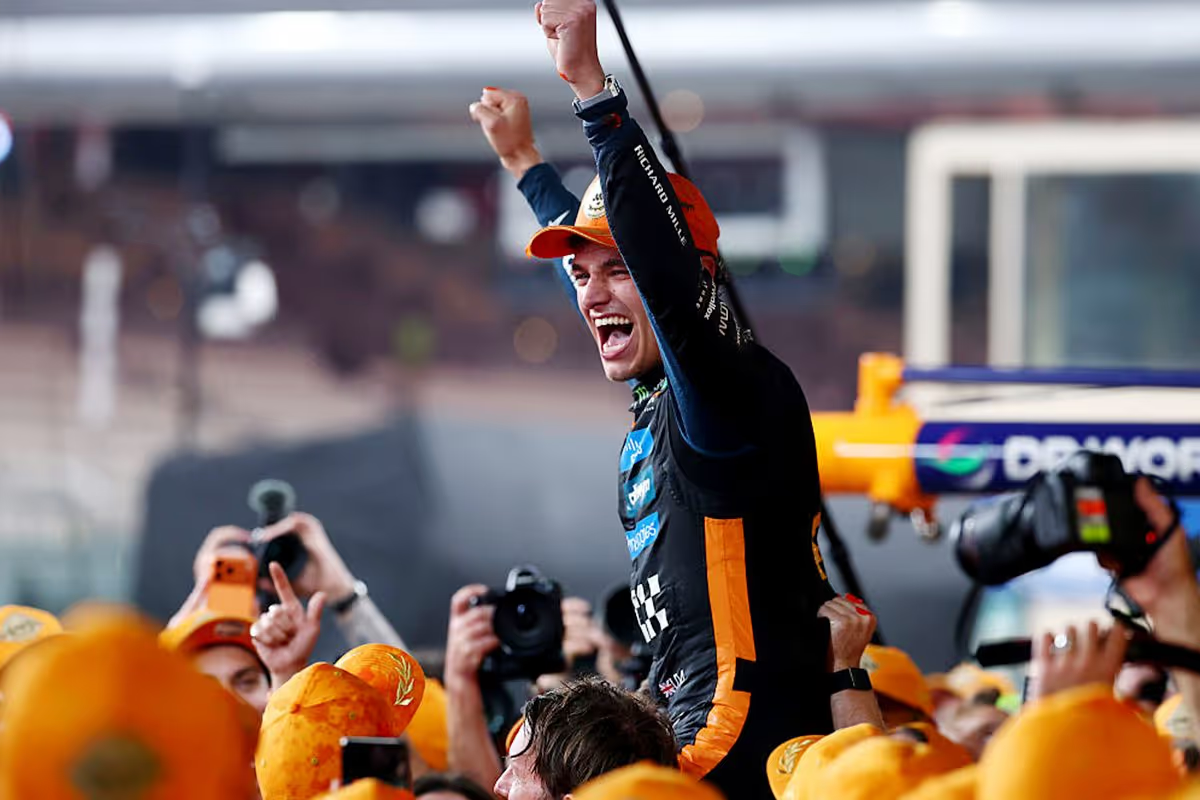
Drive to Survive didn’t explain Formula 1. It created emotional entry points, turning a niche sport into a U.S. fandom engine. Identical objects on eBay paired with stories sold for nearly 3,000% more, not because the product changed, but because belief did.
FANDOM IS WHAT BELIEF LOOKS LIKE IN THE MARKET
When belief moves from the individual to the collective, it becomes fandom.
Fandom is not community building as a marketing tactic. It’s a shift from transactional customers to identity-based relationships. Fans are worth significantly more than regular customers and drive the majority of brand advocacy. That’s not an engagement metric. It’s a business model.
THE CLEAREST PROOF APPEARS IN THE MOST CONSTRAINED CATEGORY
The clearest place to see this shift already underway is the spirits industry — one of the most constrained consumer categories in the world.
Consumption is declining. Regulation limits what brands can say. Distribution is rigid. Product differentiation is minimal. Cultural scrutiny is rising. In other words, spirits brands cannot rely on louder messaging or marketing illusion. They must prove who they are.
Over the past year, working with the Solomon Group to study leading brands within this environment, a pattern emerged: the brands outperforming expectations were not those creating bigger campaigns, but those building experiences that demonstrated credibility in real time.
BRAND HOMES ARE THE INFRASTRUCTURE THAT MAKES BELIEF REPEATABLE
Sazerac House in New Orleans exemplifies this shift. Not a showroom but a cultural landmark, visitors move through recreated historical environments and hands-on experiences that give them tools to carry the story forward. The result is not visitation, but advocacy.
Campari’s Galleria Campari embeds the brand into Italian cultural history through thousands of artworks and artifacts. Competitors can replicate a product. They cannot replicate cultural embeddedness.
Ole Smoky Moonshine demonstrates the power of systemization at scale, welcoming millions of visitors annually across multiple locations. Their advantage is not novelty; it is repeatable infrastructure.
These environments don’t declare authenticity. They enforce it.

WHAT WINNING SPIRITS BRANDS REVEAL ABOUT THE FUTURE
Spirit brands aren’t succeeding despite constraints. They’re succeeding because constraints eliminate shortcuts.
When messaging is limited and skepticism is high, experience becomes evidence. Story becomes participation. And belief becomes the primary competitive advantage. What spirits learned early, other categories are now beginning to confront.
THE MANDATE FOR EXPERIENCE BUILDERS
Stop pitching immersive as the outcome. Pitch trust, belief and belonging.
Because the brands that will win the next decade won’t just make great products or even great moments. They’ll build credible systems — places where story is witnessed, authenticity is enforced by design and fandom compounds over time.
The insights in this piece are drawn from our recent research into the spirits industry, examining how brands are responding to declining consumption, rising costs and a growing trust deficit by investing in story, authenticity and IRL experience as strategic infrastructure. You can read the full report here.
Daniel Hettwer is an XLISTER and Chief Strategy Officer at Solomon Group, where he leads strategy across the company’s Live Events and Immersive Experiences businesses, as well as a growing portfolio of ventures and IP. Working closely with the executive team, he focuses on new revenue opportunities, strategic partnerships, and aligning creative capabilities with market demand.
Previously, Daniel worked in financial engineering and investment structuring, including leading a multi-billion-dollar project pipeline in China. He is also the founder of Impactainment, a UN-accredited initiative exploring how entertainment and immersive experiences can drive social impact.